
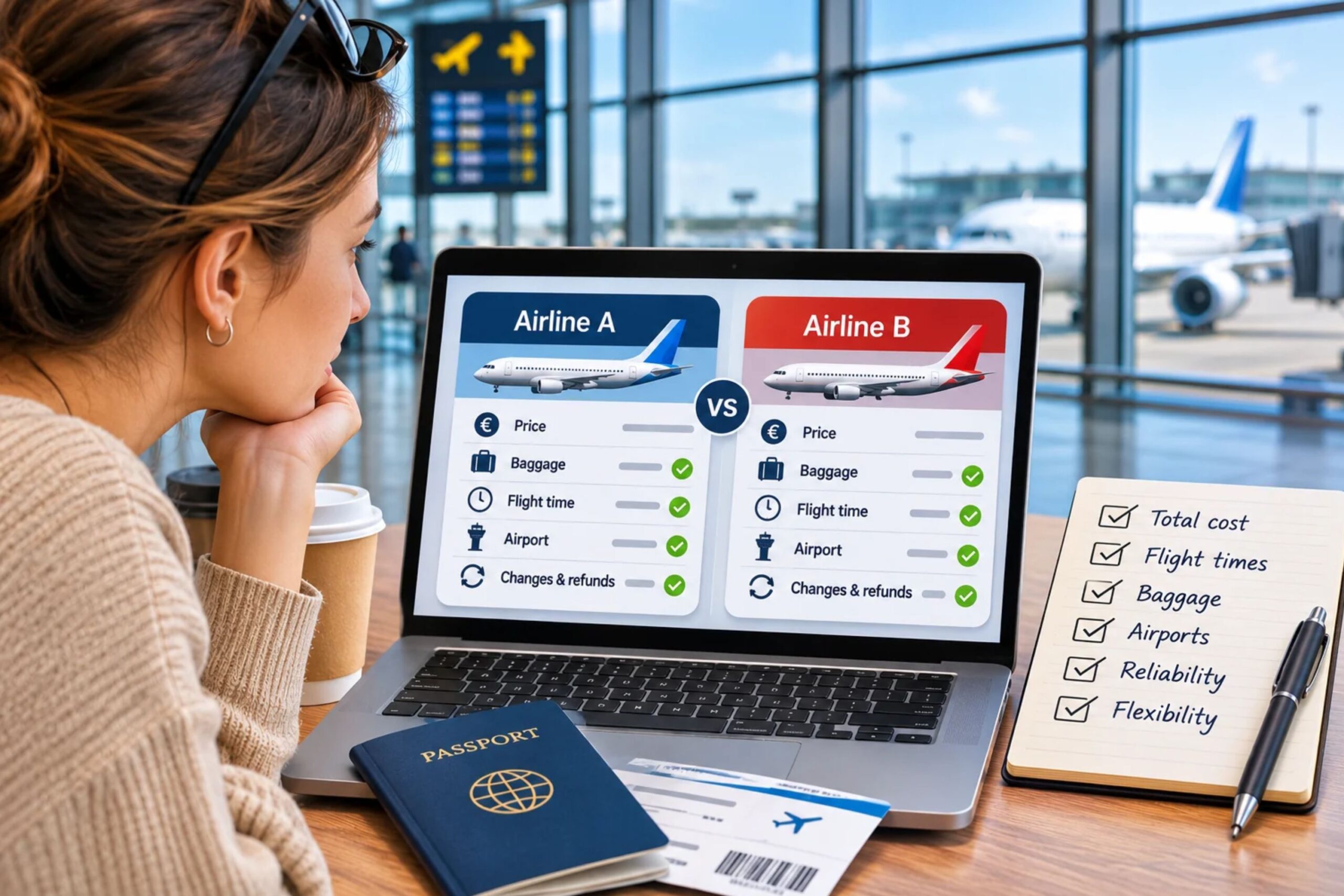
Two airlines can operate the same route but offer different prices, schedules and travel conditions. One may advertise a cheaper ticket, while the other includes checked baggage, offers a more convenient departure time or uses an airport closer to your destination.
The lowest advertised fare does not always represent the best value. To choose between two airlines, compare the full cost of the journey, the services included in the ticket and the conditions that could affect your plans.
1. Compare the Total Ticket Price
Start with the advertised fares, but check what each price includes before deciding. Airlines structure tickets differently, and a cheaper fare may exclude services another carrier includes as standard.
Compare the cost of:
- Cabin and checked baggage
- Seat selection
- Priority boarding
- Airport check-in, if charged
- Payment or booking fees
- Ticket changes and cancellations
For example, Airline A may offer a ticket for €75, while Airline B charges €105. If Airline A adds €25 for a checked bag and €12 for seat selection, its total reaches €112. Airline B may already include both services, making its higher advertised fare cheaper overall.
Check the same services for both airlines before comparing prices. The additional fees airlines charge can make a noticeable difference in the final booking cost.
2. Check Departure and Arrival Times
A convenient schedule can make one airline a better choice, even if its ticket costs slightly more.
Compare departure and arrival times, total flight duration, and the time needed to reach each airport. Also consider what happens after landing. A flight that arrives late at night may require an expensive taxi or an extra hotel night. An early departure could mean arranging transport before public services start.
For international routes, check the local times shown for both airports and account for time zone differences. A flight that appears shorter on the booking page may not offer the most convenient overall journey.
Choose the schedule that fits your plans rather than automatically selecting the shortest flight.
3. Compare the Airports Used by Each Airline
Two airlines serving the same city pair may use different airports. This can affect transfer costs, travel time and convenience.
Check the distance from each airport to your accommodation, available public transport, shuttle services and typical transfer times. Consider the cost of reaching your final destination as part of the flight budget.
For example, one airline may fly into a major airport near the city centre, while another uses a secondary airport farther away. The second flight might have a lower fare, but the ground transfer could cancel out the savings.
This is one reason flights from smaller airports can cost less. Compare the flight and airport transfer together rather than treating them as separate expenses.
4. Check Baggage Allowances
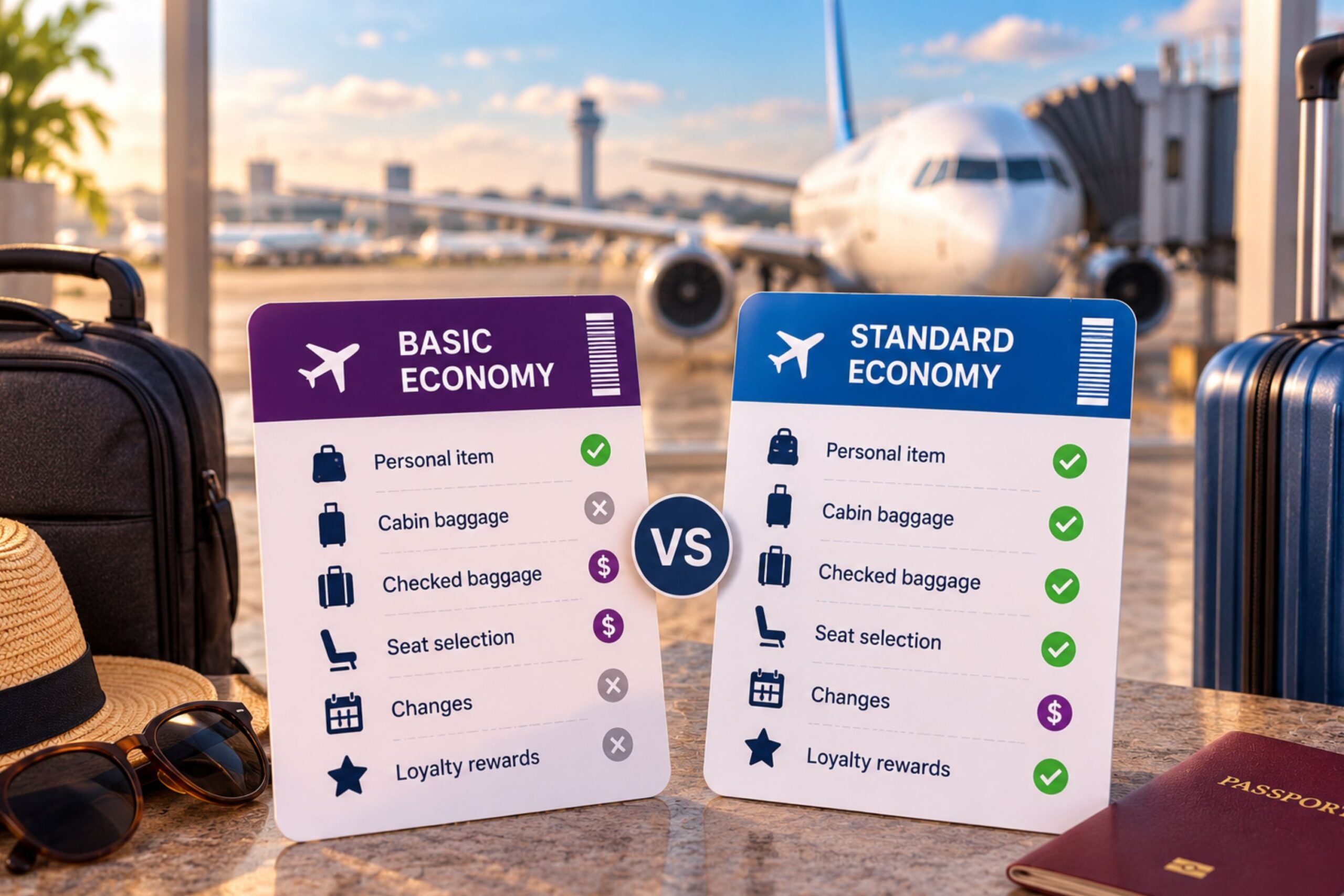
Baggage rules can differ considerably between airlines, even on the same route. Do not assume that both carriers include the same cabin bag or checked baggage allowance.
Compare:
- Personal item dimensions
- Cabin bag size and weight limits
- Checked baggage allowance
- Fees for additional or oversized luggage
- Rules for sports equipment and other special items
Pay particular attention to the difference between a personal item and a cabin suitcase. Some fares include only a small bag that fits under the seat, while a larger cabin bag requires an additional payment.
If you travel with several bags, calculate the total cost before choosing an airline. Check the baggage options available when booking a flight and confirm the allowance for the exact fare, not just the airline.
5. Review Seat Selection and Onboard Conditions
The aircraft and seating arrangements can affect comfort, especially on longer flights.
Compare seat pitch, legroom, seat width, recline options and the availability of power outlets or Wi-Fi. Also check whether meals, drinks, and entertainment are included in the fare or require an additional payment.
Services can vary between flights operated by the same airline. The aircraft type and cabin layout may differ depending on the departure, so check the details for your specific flight.
If you are travelling with family or another passenger, review the seat allocation rules. A low fare may not include advance seat selection, and choosing seats together could increase the total price.
6. Check Flight Reliability and Disruption Support
A low fare may not be worth the inconvenience if the airline frequently changes its schedule or provides limited assistance during disruptions.
Look for recent information about delays, cancellations, schedule changes and customer support. Airport performance reports and aviation statistics can help you compare punctuality, while recent passenger reviews may highlight recurring service problems.
Do not base your decision on a handful of negative reviews. Look for patterns across several sources and check how recently the feedback was published.
Also review what happens if the airline cancels or significantly changes your flight. Passenger rights depend on the route, departure location, destination and applicable regulations. If you have an important appointment or a connecting journey, clear rebooking procedures may matter more than a small difference in ticket price.
7. Compare Direct Flights and Connections
If both airlines offer direct flights, compare their schedules and journey times. If one option includes a connection, consider the additional time and risks.
Check the layover duration, terminal changes, airport transfer requirements and whether both flight segments appear on one ticket. A short connection may leave little time to reach the next departure gate, while a long layover can add several hours to your journey.
Pay particular attention to missed-connection protection. If both flights are on one booking, the airline may have responsibility for arranging an alternative when a delay causes you to miss the onward flight. Separate tickets can leave you responsible for buying a replacement.
Check the rules for connecting flights and transfer arrangements before choosing an itinerary with a stop.
8. Compare Changes, Cancellations and Refund Rules
Your plans may change, so check the conditions that apply after purchase.
Compare whether changes are permitted, the applicable fees, fare differences, cancellation charges and refund eligibility. Some airlines offer several fare types, each with different restrictions.
Don’t assume a more expensive ticket automatically allows refunds. Read the conditions attached to the specific fare and check if the airline offers a travel credit instead of a cash refund.
If flexibility matters, compare the cost of a more flexible ticket with the potential expense of changing your plans later. The difference between refundable and non-refundable tickets explains the main conditions to look for.
9. Consider Loyalty Benefits
If you regularly fly with one airline, its loyalty programme may influence your decision.
Check whether the booking earns points or miles and if you can use existing benefits on the selected fare. Depending on the airline and programme, benefits may include additional baggage, priority boarding, seat selection or lounge access.
Read the programme conditions carefully. Discounted fares may earn fewer points or exclude certain benefits. Partner airlines can also apply different rules for earning and redeeming miles.
Loyalty benefits are most useful when you use them regularly. Don’t choose a more expensive flight just to collect a small number of points you may never redeem.
10. Check Who Operates the Flight
An airline may sell a ticket for a flight operated by another carrier. This arrangement is common with codeshare flights and airline partnerships.
Look for the phrase “operated by” in the flight details. The airline shown in the search results may not be the company providing the aircraft and onboard service.
The operating carrier generally determines the aircraft, cabin layout and onboard experience. Check-in procedures, baggage handling and customer support may involve more than one airline, depending on the booking.
If you prefer a particular carrier, verify the operating airline rather than relying only on the name displayed beside the flight.
Example: Choosing Between Two Airlines on the Same Route
Imagine you need to fly from Paris to Rome. Two airlines offer flights on the same day.
| Factor | Airline A | Airline B |
| Advertised fare | €75 | €105 |
| Checked baggage | €25 extra | Included |
| Seat selection | €12 extra | Included |
| Departure | 06:30 | 10:15 |
| Arrival airport | Secondary airport | Main airport |
| Ground transfer | €18 | €8 |
| Total with selected extras | €130 | €113 |
In this example, Airline B costs less once baggage, seat selection and airport transport are included. Its later departure may also suit travellers who prefer not to reach the airport early in the morning.
However, the better option depends on the passenger’s plans. Someone travelling with hand luggage only and staying near Airline A’s arrival airport may still prefer the first flight.
The comparison shows why you should evaluate each itinerary’s details instead of choosing the lowest advertised fare.
Checklist Before Booking
Before choosing between two airlines, compare these details side by side:
- Total price, including the services you need
- Departure and arrival times
- Flight duration and number of stops
- Departure and arrival airports
- Cabin and checked baggage allowances
- Seat selection and onboard facilities
- Recent reliability information
- Change, cancellation and refund conditions
- Loyalty programme benefits
- Operating airline and ticket conditions
Use the same travel dates, passenger details and baggage requirements when comparing both options. This prevents differences in search settings from affecting the results.
FAQs
Is it better to choose a low-cost airline or a full-service airline on the same route?
Neither option is automatically better. Low-cost airlines can offer lower fares for passengers travelling with minimal baggage. Full-service airlines may include additional services in the ticket price. Compare the total cost and conditions for the journey you need.
Should I choose the airline with the shortest flight time?
Not always. A shorter flight may use a less convenient airport, cost more, or arrive at an unsuitable time. Compare the entire journey, including airport transfers and check-in requirements.
Do two airlines on the same route use the same airports?
Not necessarily. Airlines may serve different airports in the same city or metropolitan area. Check the airport code on both itineraries before booking, as the difference can affect transfer time and cost.
Is booking directly with the airline better after comparing two carriers?
Booking directly can make it easier to manage reservations and contact the airline about changes. However, compare the final prices and conditions across booking channels before deciding. The differences between booking directly and using a travel agent can help you choose the best option.
Can the same flight have different prices depending on where I book?
Yes. Travel websites and booking platforms can display different prices because of fees, available fares, currency settings and other booking conditions. Make sure you are comparing the same flight, fare type, and baggage allowance; those differences are what cause different prices for the same flight.