
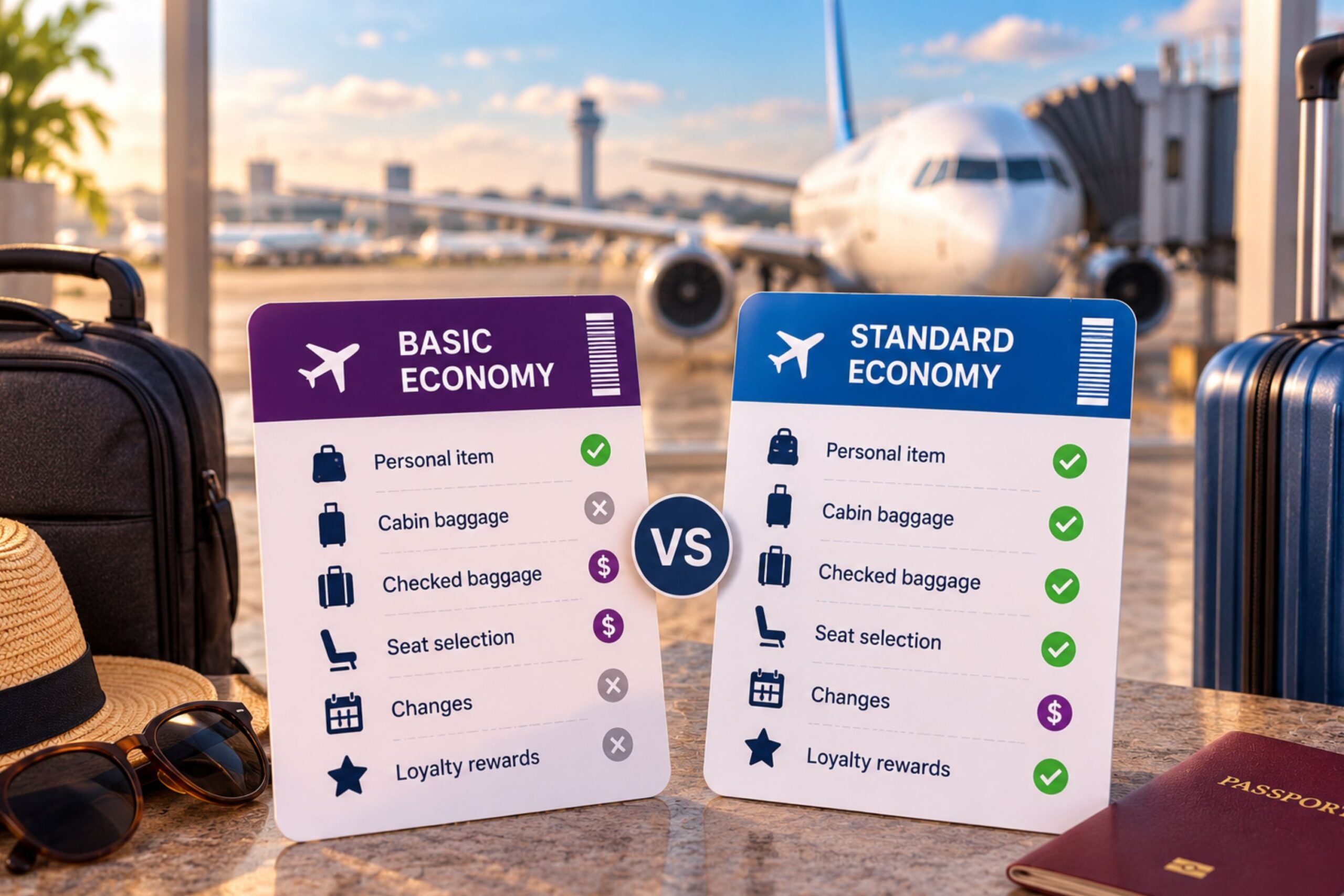
Basic economy usually offers a lower starting fare but with more restrictions, while standard economy may include benefits like advance seat selection or more flexibility. Exact differences depend on the airline, route, and fare conditions, so the cheapest ticket isn’t always the best value overall.
Both fares generally place you in the economy cabin. The main differences concern what the ticket includes and which services cost extra.
Basic economy may suit travellers with fixed plans who pack lightly and don’t mind an assigned seat. Standard economy may offer better value if you need more baggage, want to choose your seat or may need to change your travel plans.
To compare them fairly, check the total cost of each fare after adding the services you actually need.
Basic Economy vs Standard Economy: Key Differences
The following table shows common differences. Individual airlines may offer different benefits, so always check the conditions attached to the specific ticket.
| Feature | Basic economy | Standard economy |
| Starting fare | Usually lower | Usually higher |
| Personal item | Often included | Often included |
| Cabin baggage | Depends on airline and route | Depends on airline and fare |
| Checked baggage | May cost extra | May cost extra or be included |
| Seat selection | May require an additional fee | May include standard seat selection or charge for it |
| Changes and cancellations | Often more restrictive | May offer more flexibility, depending on the fare |
| Boarding priority | May be later | Depends on the airline and ticket |
| Loyalty rewards | May be reduced or excluded | May offer more reward benefits |
| Best suited to | Travellers who need few extras | Travellers who value included services or flexibility |
Do not assume that every standard economy ticket includes checked baggage, free seat selection or refundable conditions. Airlines can sell several economy fare types with different benefits on the same flight.
When Is Basic Economy Worth Booking?
Basic economy can offer good value when the lower fare outweighs the restrictions and you don’t need many paid extras.
You are travelling with minimal baggage
If you can pack everything within the airline’s free baggage allowance, basic economy may save money. Check the size and weight limits for your personal item and cabin bag before booking.
Don’t assume every basic economy ticket includes a full-size cabin bag. Some fares allow only a smaller item that fits under the seat, while others include standard cabin baggage.
If you need additional luggage, calculate the cost of adding baggage when booking cheap tickets before deciding which fare offers better value.
Your travel plans are unlikely to change
Basic economy is easier to justify when your departure date, destination and return plans are firm. Many basic fares restrict changes or cancellations after any applicable initial cancellation period.
If your plans change, you may have to pay for a replacement ticket or lose some or all of the original fare, depending on the airline’s conditions and applicable passenger rights.
Before booking, check the rules for refundable and non-refundable tickets. A non-refundable ticket doesn’t necessarily mean every cancellation scenario has the same outcome.
You do not need to choose your seat in advance
If you are travelling alone and comfortable with an assigned seat, paying extra for advance selection may not be worth it.
However, seat assignment rules vary. You may receive your seat at check-in or at another stage specified by the airline. If you want a window seat, need extra legroom or prefer to sit with other passengers, check the selection fee before choosing the cheaper fare.
The price difference is substantial
Basic economy becomes more attractive when the savings remain meaningful after you account for the services you need.
For example, if you don’t need checked baggage, advance seat selection, or ticket flexibility, paying more for standard economy may offer little practical benefit. But if the fare difference is small, standard economy’s additional inclusions could justify the higher price.
Compare the final totals rather than relying on the initial price displayed in search results.
When Is Standard Economy Better Value?
Standard economy may be the better choice when its included services or more flexible conditions offset the higher starting price.
You need baggage beyond the basic allowance
A basic fare may become more expensive once you add a cabin bag or checked luggage. Compare the baggage allowance for each ticket, including any weight limits and fees for extra pieces.
Also check whether your outbound and return flights have different baggage rules, especially if different airlines operate the journey.
You want to select your seat
If you want to sit beside a travel companion, choose an aisle or window seat, or avoid a middle seat; advance selection can matter.
Calculate the cost of choosing seats on the basic fare and compare it with standard economy. For multiple passengers, seat-selection charges can add up quickly.
Families should pay particular attention to the airline’s seating policy. Do not assume that purchasing tickets together guarantees that every passenger will receive adjacent seats.
You may need to change your flight
Standard economy may offer more flexibility if your plans are uncertain, but the fare name alone doesn’t guarantee free changes.
Check whether the airline permits changes, charges a fee, requires you to pay any fare difference or offers a travel credit after cancellation. A more expensive fare can be worthwhile if its conditions reduce the potential cost of changing plans.
If you already know your dates may change, compare the ticket conditions before paying rather than assuming you can upgrade or modify the booking later.
You want to avoid paying separately for several services
A standard fare can be more economical if it includes services that would otherwise require additional payments.
For example, a traveller who needs a cabin bag and advance seat selection should compare the standard fare against the basic fare plus both extras. If the totals are similar, standard economy may provide better value with fewer separate purchases.
How to Compare the Total Cost of Both Fares
Use the same flight, dates, passenger details and travel requirements for both options. This lets you compare the fares on a level playing field.
1. Start with the fare difference
Record the price of basic economy and standard economy for the same itinerary. Check that both options cover the same passengers and flight segments.
Do not compare a basic fare on one flight with a standard fare on a different departure time unless you also account for the differences in schedule and convenience.
2. Add the services you need
List the extras required for your trip:
- Cabin baggage or checked baggage.
- Advance seat selection.
- Any mandatory booking or payment charges.
- Additional services that matter to your journey.
Check what airlines charge extra for so you can identify costs not included in the initial fare.
3. Check the ticket conditions
Review the rules for changes, cancellations, refunds and missed flights. A lower fare may come with restrictions that matter if your plans change.
You should also confirm whether any benefits depend on your route, loyalty status or the way you booked the ticket.
4. Calculate the final price
Use this formula for both fare types:
Total ticket cost = base fare + baggage fees + seat-selection fees + booking charges + other required extras.
If you are comparing tickets for several people, multiply the relevant per-passenger costs by the number of travellers.
Here is an illustrative example.
| Cost | Basic economy | Standard economy |
| Starting fare | €120 | €155 |
| Cabin baggage fee | €35 | €0 |
| Seat selection | €18 | €0 |
| Booking charges | €5 | €5 |
| Total per passenger | €178 | €160 |
In this example, standard economy costs €18 less after the extras are included. The figures are illustrative, not live fares, and the actual result depends on the airline’s fare conditions.
If you don’t need a cabin bag or advance seat selection, basic economy may still be cheaper. The right comparison depends on what you will actually use.
Does Basic Economy Always Have Stricter Rules?
No. Airlines define their fare products differently, and the restrictions can vary by route and ticket conditions.
One airline may include a full-size cabin bag with its cheapest fare, while another may restrict the allowance. Some standard economy tickets also charge for checked baggage or advance seat selection.
The same applies to changes, cancellations and loyalty rewards. Do not assume that a fare labelled “standard economy” includes every benefit you expect.
Before paying, review the fare conditions shown during booking and check the airline’s rules for your exact itinerary. If you book through a third-party website, confirm where you must go to manage the booking or request a change.
How to Choose the Better-Value Economy Fare
Use this checklist before booking:
- Compare basic and standard economy on the same flight.
- Confirm the personal-item and cabin-baggage allowances.
- Add checked-baggage fees if you need them.
- Check the price of selecting seats in advance.
- Compare change and cancellation conditions.
- Include booking and payment charges.
- Calculate the final price for every passenger.
- Decide whether the additional benefits justify any remaining price difference.
If you are still comparing routes or booking websites, use flight comparison sites to find suitable options, then verify the fare details before you buy.
Compare the final price of basic and standard economy for your chosen itinerary, including the services you need. Choose the fare that fits your budget and travel plans, rather than relying on the lowest advertised price alone.
FAQs
Can I upgrade from basic economy to standard economy after booking?
This depends on the airline, route and fare rules. Some airlines allow certain upgrades or paid options, while others restrict fare-type changes. Check the available options before booking, because an upgrade may cost more than purchasing standard economy initially.
Does basic economy affect travel insurance?
The fare type does not automatically determine your travel insurance coverage. What matters is the policy wording, the reason for a claim and the restrictions attached to your ticket. If you are concerned about cancellation or disruption costs, check the policy before purchasing insurance and confirm what it covers.
Is basic economy suitable for international flights?
It can be, but baggage allowances, seat-selection rules and change restrictions vary by airline and route. On a longer trip, extra baggage or the need for more flexibility may reduce the initial savings. Compare the full fare conditions for each international itinerary.
Can I earn frequent-flyer points with basic economy?
Some airlines limit or exclude loyalty rewards on certain basic fares, while others offer reduced earning or apply different rules to eligible members. Check the airline’s current loyalty programme terms for your specific ticket rather than assuming that every economy fare earns the same rewards.
Is standard economy refundable?
Not necessarily. Standard economy describes a fare category, not a universal refund policy. Some tickets allow refunds under specific conditions, while others are non-refundable. Check the fare rules and applicable passenger rights before booking.