


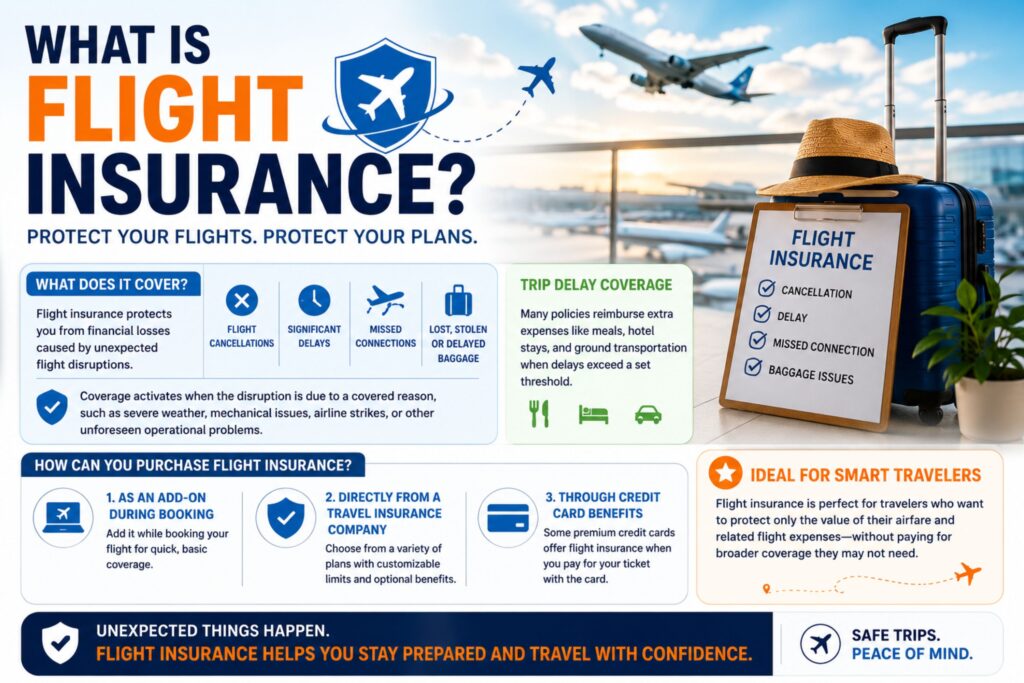
Flight insurance is a specialized form of air travel protection that applies exclusively to flights. Its primary purpose is to reduce financial losses caused by flight disruptions. These disruptions can include cancellations, significant delays, missed connections, and lost, stolen, or delayed checked baggage.
Coverage typically activates when the disruption is due to a covered reason stated in the policy, such as severe weather, mechanical issues, airline strikes, or other unforeseen operational problems.
Many policies also include trip delay coverage to reimburse extra expenses like meals, hotel stays, and ground transportation when delays exceed a set threshold.
You can purchase flight insurance in several ways:
- As an add-on during airline ticket booking for quick, basic coverage.
- Directly from a travel insurance company with customizable policy limits and optional benefits.
- Through premium credit card benefits when you pay for your ticket with the card.
Flight insurance is ideal for travelers who want to protect only the value of their airfare and related flight expenses, without paying for broader coverage they may not need.
How does flight insurance differ from general travel insurance?
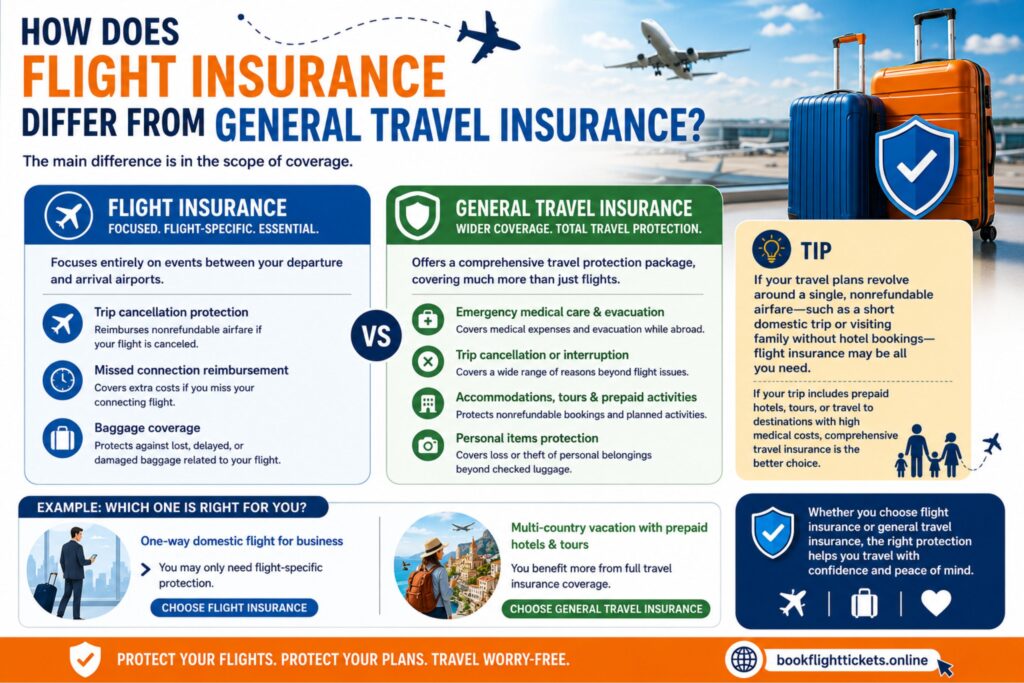
The main difference is in the scope of coverage. Flight insurance focuses entirely on events between your departure and arrival airports. It provides trip cancellation protection, missed connection reimbursement, and baggage coverage for issues directly related to your flights.
General travel insurance offers a comprehensive travel protection package, covering much more than just flights. This often includes:
- Emergency medical care and evacuation while abroad.
- Trip cancellation or interruption for a wide range of covered reasons beyond flight issues.
- Coverage for accommodations, tours, and prepaid activities.
- Protection for personal items outside of checked luggage.
Tip: If your travel plans revolve around a single, nonrefundable airfare—such as a short domestic trip or visiting family without hotel bookings—flight insurance may be all you need. If your trip includes prepaid hotels, tours, or travel to destinations with high medical costs, comprehensive travel insurance is the better choice.
Example: A traveler taking a one-way domestic flight for business may only require flight-specific protection, whereas someone on a multi-country vacation with prepaid accommodations benefits more from full travel insurance coverage.
What does flight insurance typically cover?
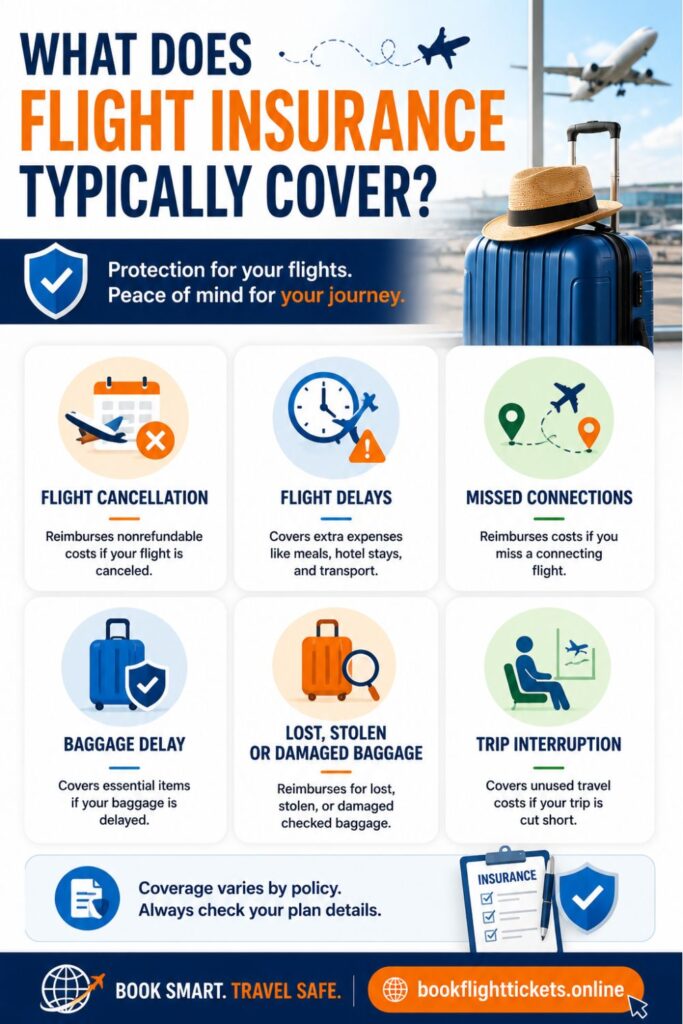
Although specific benefits depend on the provider and policy, most flight insurance plans focus on protecting travelers from the most common and costly flight-related issues. Core coverage areas usually include:
- Flight cancellations can occur due to covered reasons, such as severe weather, airline strikes, mechanical failures, or other unexpected operational problems. Reimbursement is generally for the nonrefundable ticket cost and related prepaid expenses.
- Trip delay coverage for delays beyond a set number of hours, with reimbursement for meals, hotel stays, and essential items purchased during the wait.
- Missed connection reimbursement if a covered delay or cancellation causes you to miss a connecting flight, including rebooking costs and additional ground transport if necessary.
- Baggage protection for lost, stolen, or damaged checked luggage, as well as baggage delay coverage to purchase necessities while waiting for your belongings.
- Trip interruption benefits if you must cut your trip short for a covered reason, such as a family emergency or unexpected illness, with compensation for unused airfare.
Some policies also provide fixed-benefit payouts—a set amount for specific incidents, regardless of actual costs, which can simplify claims.
Example: If your flight from New York to London is cancelled due to a snowstorm, your flight insurance could reimburse the full value of your nonrefundable ticket, plus eligible expenses for meals, lodging, and alternative transportation, up to your policy limit.
What does flight insurance usually exclude?
Understanding policy exclusions is essential to avoid unexpected claim denials. Flight insurance is designed to cover specific flight-related risks, but there are clear situations where benefits will not apply. Common exclusions include:
- Medical emergencies, hospitalization, or evacuation — these are generally covered under comprehensive travel insurance, not flight-only policies.
- Adventure sports or hazardous activities — incidents resulting from high-risk activities such as skydiving, mountaineering, or scuba diving may be excluded.
- Voluntary flight changes — if you choose to change your travel dates or route for personal reasons, your policy will not reimburse the cost.
- Delays caused by non-covered reasons — disruptions due to airline staffing shortages, routine maintenance, or minor schedule adjustments might not qualify unless explicitly listed as covered reasons.
- Pre-existing conditions — cancellations or delays caused by health issues that existed before purchasing the policy are usually excluded unless a pre-existing condition waiver is included.
- Known events at the time of purchase — for example, buying insurance after a storm warning or strike announcement typically removes coverage for those events.
Tip: Always read the “covered reasons” and “exclusions” sections of your policy in full. This helps you understand exactly when air travel protection applies and prevents assumptions about what’s included.
Example: If your flight is cancelled because the airline’s IT system crashes unexpectedly, that may be covered. But if you decide to rebook your trip to extend your holiday, that’s considered a voluntary change and won’t qualify for reimbursement.
How does flight insurance work?
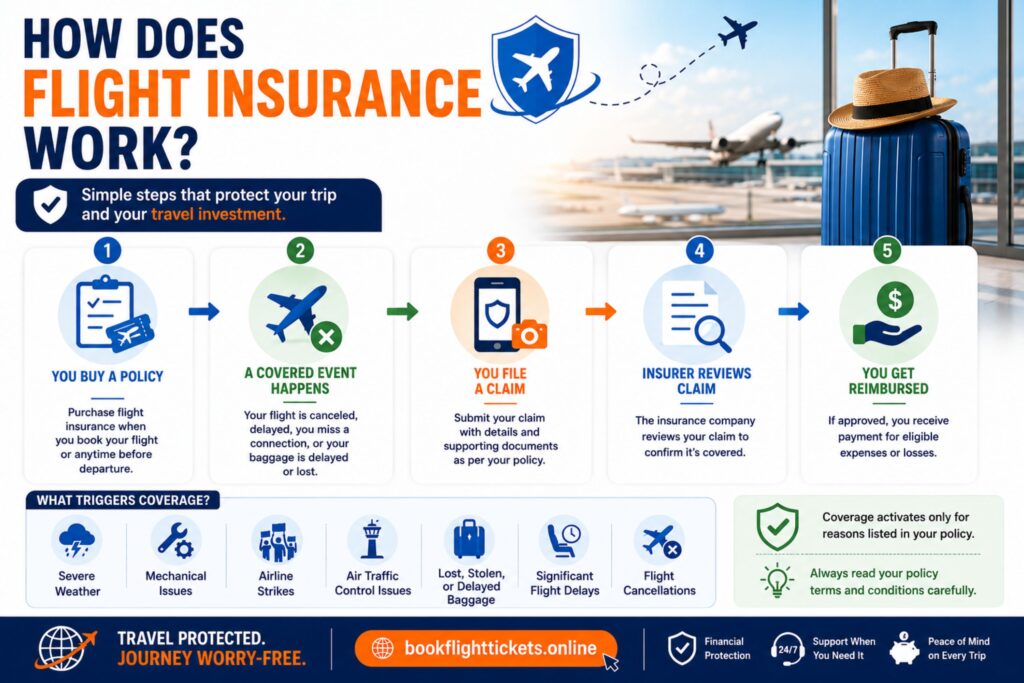
The flight insurance claims process is straightforward, but understanding the correct steps ensures faster approval and payout. When a covered incident—such as a cancellation, long delay, or lost baggage—occurs, most policies follow this sequence:
- Contact the airline first
Airlines are your primary source of assistance under their contract of carriage. They may offer rebooking options, flight vouchers, meal or hotel accommodation, or partial refunds. Insurance benefits typically apply only after any airline compensation has been used. - Submit a claim to your insurance provider
File your claim as soon as possible, either through the insurer’s website, mobile app, or customer service. You will need to provide proof of the disruption—this may include boarding passes, official delay or cancellation notices, baggage claim reports, and receipts for expenses like meals, taxis, or hotels. - Claims review and approval
The insurer verifies that the disruption meets the policy’s covered reasons and calculates the reimbursement amount within your policy limits. This review process can take a few days to several weeks, depending on the complexity of the claim and the completeness of your documentation. - Receive compensation
Once approved, payments are usually sent via bank transfer, check, or travel credit. Some providers also offer fixed-benefit payouts that don’t require detailed receipts, making the process faster.
Automation advantage:
Certain insurers use real-time flight tracking to detect delays and cancellations automatically. This can trigger pre-approval for claims without requiring you to initiate the process, significantly reducing wait times for compensation.
Example: If your flight from Chicago to Toronto is delayed for more than six hours due to a snowstorm, your policy may automatically authorize a set payout for meals and hotel accommodation without you needing to file manually.
How much does flight insurance cost?
The cost of flight insurance is usually calculated as a percentage of your airfare or charged as a flat fee. For most travelers, premiums range from 5% to 10% of the total ticket price. This means a nonrefundable ticket priced at $400 could cost between $20 and $40 to insure.
Some providers offer flat-rate plans, which charge a set price regardless of ticket cost—often between $20 and $30. These plans typically include standard benefits such as trip delay coverage, baggage protection, and cancellation reimbursement for covered reasons.
Factors that influence premium rates include:
- Airfare cost — higher ticket prices mean higher percentage-based premiums.
- Coverage limits — policies with higher maximum payouts cost more.
- Destination — flights to remote or higher-risk destinations may have higher premiums.
- Add-on benefits — features like cancel for any reason or extended baggage protection increase the total cost.
Example: For a $750 international ticket, a 7% premium rate would equal $52.50. A flat-rate plan priced at $25 might be more economical, but it could offer lower coverage limits compared to a percentage-based policy.
Tip: Always compare policy inclusions and limits, not just price. A slightly higher premium may provide more generous air travel protection and faster claims processing.
When is flight insurance worthwhile?
Flight insurance offers the best value in situations where your primary concern is protecting the cost of your airfare and related flight expenses. It is particularly beneficial when:
- Your only significant prepaid expense is your ticket — ideal for trips where accommodation is free or paid on arrival, such as visiting family or attending events with no hotel costs.
- You booked a nonrefundable airfare, which ensures you can recover your costs if a covered reason forces you to cancel or change your flight.
- You are flying during peak travel seasons — such as holidays, summer vacations, or major events, when weather disruptions, congestion, and airline overbooking are more common.
- You lack other forms of flight protection, for example, if your credit card or comprehensive travel insurance policy does not include trip delay coverage, missed connection reimbursement, or baggage protection.
When it may not be necessary:
- Refundable or flexible tickets — you can change or cancel without losing your investment.
- Airlines with generous change policies — especially those offering free rebooking or credit vouchers for schedule changes.
- Comprehensive travel insurance already in place — many travel policies include all core benefits of flight insurance along with additional protections.
Tip: Before purchasing, review all existing protections from your airline, credit card, or travel insurance provider. Avoid paying twice for the same benefit, and focus on filling only the coverage gaps.
Example: A traveler with a nonrefundable $600 ticket to a winter destination during snowstorm season, and no credit card travel benefits, is a strong candidate for standalone flight insurance.
What buying channels are available for flight insurance?
Travelers can purchase flight insurance through several different channels, each offering varying levels of coverage, flexibility, and cost:
- Airline add-on during checkout – The quickest option, offered when purchasing your ticket. This is convenient but often provides limited benefits and lower policy limits compared to standalone coverage.
- Standalone flight insurance from a travel insurance provider – Bought directly from an insurer, either online or through a broker. This option typically offers more flexible coverage options, higher limits, and the ability to add benefits such as cancel for any reason or extended baggage protection.
- Credit card travel benefits – Many premium travel credit cards include built-in flight protection when you use the card to pay for your ticket. Benefits may include trip delay coverage, missed connection reimbursement, and baggage protection.
Tip: Always compare coverage amounts, policy exclusions, and claim procedures before deciding. Airline-offered insurance may be sufficient for basic trip delay coverage, but standalone plans often provide broader benefits and higher payouts.
Example: If your credit card includes $500 in trip delay benefits but your flight and potential hotel expenses exceed that, purchasing a separate standalone policy with higher limits may be worthwhile.
Which tools or providers simplify claims and coverage of the flight unsurance?
Modern flight insurance providers increasingly use technology to make the claims process faster, more transparent, and easier for travelers. Key features to look for include:
- Mobile insurance apps – Allow you to submit claims instantly, upload supporting documents (such as receipts and delay notices), and monitor claim status in real time.
- Real-time flight tracking systems – Some insurers automatically monitor your flight’s status. If a delay or cancellation meets the policy’s covered reason, the system triggers the claim process without requiring you to contact them.
- Automated payouts – Certain providers offer fixed-benefit payments for delays or missed connections, sending funds directly to your account within hours instead of waiting for a lengthy review.
- Integrated policy management tools – Access and modify your policy details, view coverage limits, and download documents instantly from your phone or computer.
Example: If your connecting flight is missed due to a late arrival, an insurer with real-time delay detection can automatically approve a payout for your extra hotel night and meals—sometimes within the same day—saving you from weeks of back-and-forth communication.
Tip: When choosing a provider, evaluate not just the coverage terms but also their claims handling reputation. A firm policy paired with fast, reliable claims support ensures you actually receive the benefits you’re paying for.
Flight Insurance vs General Travel Insurance
| Feature | Flight Insurance | General Travel Insurance |
| Coverage Scope | Focused on flight-specific issues such as cancellations, significant delays, missed connections, and baggage problems directly tied to air travel. | Comprehensive coverage for multiple trip components, including flights, accommodations, tours, prepaid activities, and other travel-related expenses. |
| Medical Coverage | Not included – does not provide coverage for medical emergencies or evacuation. | Included in most policies, covering emergency treatment, evacuation, and sometimes dental care while abroad. |
| Trip Interruption Protection | Available only when directly linked to a covered flight disruption (e.g., flight cancellation causing early return). | Covers a wide range of emergencies, including illness, injury, family emergencies, or natural disasters affecting the trip. |
| Baggage Coverage | Includes checked baggage protection and sometimes carry-on coverage, with reimbursement for lost, stolen, or delayed items. | Offers broader baggage protection, often with higher claim limits and extended coverage for personal belongings during the entire trip. |
| Cost | Lower cost – typically 5–10% of the ticket price or a flat-rate premium for set benefits. | Higher cost – calculated on the total trip cost and coverage limits, often 4–12% of the overall value. |
| Best For | Ideal for travelers with only flight-related expenses, short domestic trips, or nonrefundable airfare without other prepaid trip components. | Ideal for travelers requiring comprehensive trip protection, particularly for international or multi-stop itineraries that include prepaid hotels, tours, and activities. |
Quick Flight Insurance Checklist
Before purchasing flight insurance, use this checklist to ensure the policy provides the right level of air travel protection for your needs:
- Confirm coverage scope – Verify that the policy includes trip cancellation protection, trip delay coverage, and baggage protection for lost, stolen, or delayed items.
- Know your policy limits – Review the maximum payout for each benefit, such as reimbursement amounts for trip delays, missed connections, or baggage claims.
- Check exclusions – Identify situations not covered, including pre-existing conditions, voluntary flight changes, or non-covered reasons for delays.
- Compare policy sources – Assess differences between airline add-on insurance, standalone flight insurance from a travel insurer, and credit card travel benefits.
- Purchase promptly – Some benefits, like “cancel for any reason” or pre-existing condition waivers, are available only if purchased within a specific window after booking.
- Keep documentation organized – Save boarding passes, receipts, airline delay notices, and baggage claim reports, as these are essential for a smooth claims process.
Tip: Taking 10 minutes to check these items before buying can help you avoid coverage gaps and ensure faster claim approvals if a disruption occurs.
Does flight insurance cover airline strikes or tech glitches?
Many flight insurance policies treat airline strikes and certain operational failures—such as system outages or scheduling software malfunctions—as valid covered reasons for trip cancellation or delay claims.
If your flight is affected, you may be eligible for nonrefundable airfare reimbursement and, in some cases, additional benefits like trip delay coverage for meals, lodging, and alternative transport.
However, coverage is not guaranteed across all policies. Each insurer defines “covered reasons” differently. For example, an airline strike might be covered if it is announced after you purchase the policy, but excluded if it was public knowledge beforehand.
Similarly, a technology failure may be covered if it is sudden and outside the airline’s control, but not if it’s part of routine maintenance.
Tip: Always review your policy’s event timing requirements and definitions for operational disruptions. This ensures you understand whether delays caused by strikes, airline IT glitches, or other unexpected failures qualify for reimbursement.
Example: If a nationwide air traffic control system outage forces your airline to cancel your flight, a policy that lists “mechanical or system failure” as a covered reason could reimburse your unused ticket and extra expenses up to your policy limit.
How soon should I buy flight insurance after booking?
You can purchase flight insurance at almost any point before your departure date, but buying early often provides the widest coverage and access to additional benefits.
Many insurers offer enhanced options—such as broader trip cancellation protection, a pre-existing condition waiver, or cancel for any reason (CFAR) coverage—only if the policy is purchased within a specific purchase window, typically 10–14 days after booking your flight.
Buying promptly also ensures you’re protected against events that may arise well before departure, such as airline strikes, severe weather forecasts, or personal emergencies that could force you to cancel. Waiting too long could mean these events are classified as known circumstances and excluded from coverage.
Tip: Mark your calendar to review and finalize your air travel insurance as soon as your booking is confirmed. This helps secure maximum protection, avoids coverage gaps, and ensures eligibility for valuable add-on benefits.
Example: If you book a nonrefundable ticket in January for a June trip, purchasing flight insurance within two weeks can give you CFAR protection and coverage for unforeseen issues—whereas buying in May may limit you to only basic benefits.
Will flight insurance cover prepaid miles or award tickets?
Most flight insurance policies do not reimburse the actual value of frequent flyer miles or loyalty program points used to book an award ticket. Instead, coverage typically applies only to the cash portion of the booking—such as taxes, fees, and service charges—paid out of pocket at the time of reservation.
Some policies also cover redeposit fees charged by airlines or loyalty programs if you must cancel an award ticket for a covered reason. These fees can range from $50 to over $200 per ticket, so having them reimbursed can make a significant difference when rebooking.
Tip: If you regularly book travel with points or miles, check whether your air travel protection policy includes award ticket coverage and redeposit fee reimbursement. Not all insurers offer this benefit, and limits can vary widely.
Example: If you use 60,000 miles plus $150 in taxes to book an international ticket and must cancel due to a covered medical emergency, your flight insurance may refund the $150 in taxes and the $125 redeposit fee, but not the 60,000 miles themselves.
Does my credit card already include flight insurance?
Many premium travel credit cards include built-in flight protection benefits when you use the card to purchase your ticket in full. These benefits often cover trip delay protection, trip cancellation reimbursement, missed connection coverage, and baggage loss or delay insurance. The specific limits and covered reasons vary by card issuer and network.
While some cards offer generous air travel protection, their payout limits may be lower than those of standalone policies, and coverage may exclude certain causes of disruption. For example, a card may reimburse up to $500 for a trip delay, whereas a standalone flight insurance plan could offer $1,000 or more for the same event.
Tip: Review your credit card’s benefits guide before purchasing separate coverage. If your existing benefits leave gaps—such as lower reimbursement limits, narrower covered reasons, or no baggage protection—you can buy supplemental flight insurance to extend or enhance your coverage.
Example: If your credit card includes $300 in baggage delay benefits but you’re flying with expensive equipment, adding a standalone policy with higher baggage coverage could provide complete protection in case of loss or delay.
Can I claim from both the airline and my insurance?
Yes. In most cases, you are expected to seek primary compensation from the airline first, by its contract of carriage and applicable passenger rights regulations. This may include rebooking, fare refunds, meal vouchers, or hotel accommodation.
Once the airline has provided its compensation, you can submit a claim to your flight insurance provider for any remaining eligible expenses not covered by the airline, up to your policy limits. This ensures you are made financially whole without receiving duplicate payments for the same cost.
Tip: Keep all receipts, airline communications, and proof of reimbursement. Your insurer will require these to process your claim efficiently. This documentation helps them determine what costs are still outstanding after the airline’s payment.
Example: If your flight is cancelled and the airline refunds 60% of your nonrefundable fare but does not cover the cost of an overnight hotel stay and meals, your flight insurance may reimburse these additional expenses under trip delay coverage or cancellation protection.
What documentation do I need to support a claim?
Successful flight insurance claims depend on providing complete and accurate supporting documentation. Insurers require proof that a covered reason caused your disruption and that your claimed expenses are valid. Typical documents include:
- Boarding passes or e-tickets – to verify your scheduled travel and confirm that you were booked on the affected flight.
- Official delay or cancellation notices from the airline – these may be issued at the airport, sent via email, or available in your airline’s mobile app.
- Baggage claim reports – provided by the airline when reporting lost, delayed, or damaged luggage, along with any receipts for replacement items purchased.
- Receipts for additional expenses – such as meals, hotel stays, taxis, or alternative transport incurred during a delay or after a cancellation.
Tip: Organize all documents chronologically and keep both physical and digital copies. Many insurers allow claim submission through mobile apps, so having clear scanned copies can speed up processing.
Example: If your flight is delayed 12 hours and you purchase $80 in meals and a $150 hotel stay, submitting your boarding pass, the airline’s official delay notice, and all receipts will help your air travel protection provider approve your trip delay coverage claim quickly.
Does flight insurance apply to international flights?
Yes. Most flight insurance policies provide coverage for both domestic and international travel, as long as the flights fall within the policy’s geographic coverage area. The key is to confirm that the insurer includes the specific countries, regions, and transit points on your itinerary.
Some policies have territorial restrictions or exclude specific destinations due to political instability, sanctions, or elevated travel risks. For multi-country trips, it’s essential to verify that coverage applies not only to your primary destinations but also to layover airports and transit stops, as disruptions can occur at any point in your journey.
Tip: Review the policy’s “covered regions” or “territory” section carefully. If any part of your route passes through an excluded country—even for a short connection—you may not be covered for delays, cancellations, or missed connections in that location.
Example: If you’re flying from New York to Bangkok with a layover in Doha, your air travel protection policy must cover both Qatar and Thailand for you to be eligible for benefits if a flight disruption occurs at either airport.
Are “cancel for any reason” add-ons available for flight insurance?
Yes. Some flight insurance providers offer “cancel for any reason” (CFAR) coverage as an optional upgrade. This benefit allows you to cancel your trip for any reason not listed among the standard covered reasons in your base policy—such as a change of plans, scheduling conflict, or personal preference—and still receive a partial reimbursement of your prepaid airfare.
CFAR typically reimburses 50–75% of nonrefundable costs, depending on the insurer and policy terms. While it adds flexibility, it also increases the total premium and comes with specific requirements:
- Purchase window – CFAR must usually be bought within 10–14 days of your initial flight booking.
- Cancellation deadline – Most policies require that you cancel at least 48 hours before your scheduled departure to be eligible for reimbursement.
Tip: CFAR is most valuable if you anticipate potential changes in your travel plans or want maximum flexibility, especially for high-cost, nonrefundable tickets.
Example: If you buy a $900 nonrefundable ticket and later decide not to travel for personal reasons, a CFAR upgrade could reimburse you up to $675, depending on the policy’s reimbursement percentage.
What’s not covered by flight insurance?
Like all insurance policies, flight insurance has specific exclusions—situations where benefits will not apply. While exact terms vary by provider, typical non-covered scenarios include:
- Medical expenses unrelated to a flight incident – treatment, hospitalization, or evacuation for illness or injury during your trip are generally not included unless you have comprehensive travel insurance.
- Voluntary changes by the traveler – choosing to change or cancel your flight for personal convenience is not a valid claim, even if the ticket is nonrefundable.
- Known extreme weather events before booking – if a storm, hurricane, or other disruptive weather was publicly forecast or named before you purchased coverage, related disruptions may be excluded.
- Government travel bans, restrictions, or advisories in effect before purchase – cancellations due to pre-existing official limits are usually not covered.
- Pre-existing conditions without a waiver – cancellations or delays caused by medical conditions that existed before policy purchase may be excluded unless your plan includes a pre-existing condition waiver.
Tip: Always read the fine print in the policy’s “exclusions” and “covered reasons” sections. This ensures you understand exactly when air travel protection applies and helps avoid denied claims.
Example: If you buy flight insurance after a major airline announces a strike, that strike will likely be considered a known event and excluded from coverage.
FAQs
1. Can I upgrade my flight insurance after purchase?
In most cases, you can upgrade coverage before your departure date, such as adding baggage protection or increasing policy limits, but additional benefits like “cancel for any reason” usually have strict purchase deadlines.
2. Does flight insurance cover overbooked flights?
Some policies include compensation for denied boarding due to overbooking, primarily if the airline does not provide adequate rebooking or reimbursement under passenger rights regulations.
3. Will flight insurance cover delays caused by airport security checks?
Delays caused by standard security procedures are typically excluded. Still, if a security incident halts airport operations and meets your policy’s covered reasons, you may be eligible for trip delay benefits.
4. Can I buy flight insurance for a one-way ticket?
Yes. Many insurers offer one-way coverage that applies from departure until arrival at your destination, covering cancellations, delays, and baggage issues during that single trip.
5. Does flight insurance apply to charter flights?
Some policies cover chartered flights if they meet safety and licensing requirements, but coverage for private aviation or unscheduled services varies by insurer.
6. Are infants and children covered under flight insurance?
Most policies allow you to add minors to your plan, providing the same trip delay, cancellation, and baggage benefits as adults, often at reduced or no extra cost.
7. Does flight insurance cover missed cruises due to flight delays?
If your flight delay meets the covered reasons in your policy, it may reimburse extra transport costs to catch your cruise departure or cover missed itinerary segments.
8. Can flight insurance cover multiple flights in one trip?
Yes. Multi-leg policies can protect all segments of your itinerary, including domestic and international connections, as long as they are booked under the same trip plan.
9. Will flight insurance cover missed events or conferences?
If a covered flight disruption causes you to miss a prepaid event, some insurers reimburse the nonrefundable cost, provided it’s listed under eligible trip interruption benefits.
10. Can I transfer my flight insurance to another traveler?
Most policies are non-transferable, but some providers allow name changes before the policy takes effect, especially for group or corporate bookings.
11. Does flight insurance cover alternative transportation like trains or buses?
If your flight is cancelled or significantly delayed, certain policies will reimburse the cost of alternative transport to your destination, such as a train ticket or bus fare.
12. Is flight insurance valid if I book through a travel agent?
Yes. Whether you book directly with an airline, online, or via a travel agency, flight insurance can be applied as long as the policy is purchased for that ticket.
13. Does flight insurance include lounge access during delays?
Some premium plans offer airport lounge access or reimbursement for day passes when a delay exceeds the policy’s minimum qualifying hours.
14. Will flight insurance cover pet travel on the same booking?
If your pet is traveling in the cargo hold on your flight, certain insurers offer limited compensation for delays, cancellations, or mishandling, but this is not standard.
15. Does flight insurance cover visa or entry denial?
Most policies exclude coverage for denied entry due to visa issues, passport validity problems, or missing travel documents.
16. Can I get flight insurance for domestic budget airlines?
Yes. Low-cost carriers are eligible for flight insurance coverage, but benefits and limits remain the same regardless of airline pricing.
17. Will flight insurance reimburse seat upgrade fees?
If a covered cancellation or schedule change causes you to lose a prepaid seat selection or upgrade, some policies will reimburse those fees.
18. Does flight insurance apply if I pay for my ticket in installments?
Yes, but coverage becomes active only after the policy is issued and the trip deposit is paid. The total insured amount should match the ticket’s final cost.
19. Can I buy flight insurance for last-minute bookings?
Yes, coverage can often be purchased up until the day before departure, though certain benefits like CFAR or pre-existing condition waivers may not be available.
20. Does flight insurance cover code-share flights with multiple airlines?
If your itinerary involves code-share flights booked under one ticket, most policies cover all segments, provided they fall within the insured trip’s terms and destinations.