


Flights from smaller airports sometimes cost less because airlines face lower operating costs, different competitive pressure, and more targeted route strategies at those airports. Smaller airports often charge lower landing fees, host fewer dominant carriers, and attract airlines that use price-sensitive strategies to fill seats.
For travelers preparing to book flights, comparing nearby smaller airports can reveal lower fares, different fare classes, and alternative routing options that reduce total ticket pricing without changing the destination.
Understanding why these differences occur allows you to compare airports strategically instead of searching only by city name.
Why Smaller Airports Can Offer Lower Fares
Smaller airports can offer lower fares because airlines typically face lower operating costs, reduced congestion, and stronger price competition at these airports compared to major hubs. Lower airport charges, more flexible scheduling, and the presence of low-cost carriers directly affect airfare pricing and seat availability.
Airports charge airlines for landing fees, terminal usage, gate access, ground handling, and passenger services. Large international hubs often have higher infrastructure costs and higher passenger volume, which increases these charges. Airlines factor these expenses into base fares and total ticket pricing. When airport fees are lower, airlines have more flexibility to publish competitive fares without reducing profitability.
Operational efficiency also plays a key role. Smaller airports usually experience less runway congestion and fewer slot restrictions. Aircraft can land, unload, reload, and depart more quickly. Faster turnaround times improve aircraft utilization, which reduces cost per seat. Lower operating cost per flight allows airlines to release lower fare classes on selected routes.
Competition structure differs as well. Major hub airports are often dominated by legacy carriers that control a large share of departure slots. Reduced competition can stabilize fares at higher levels. In contrast, smaller airports frequently attract low-cost airlines and regional carriers that compete aggressively on price to stimulate demand and increase load factors.
Airfare pricing also responds to how airlines manage demand and capacity, which is influenced by dynamic pricing for airlines. When cost structure and competitive pressure differ between airports, fare algorithms adjust accordingly, creating measurable pricing differences for the same destination.
How Airline Route Strategy Influences Smaller Airport Pricing
Airline route strategy influences smaller airport pricing because carriers design network structures, aircraft allocation, and fare classes differently depending on airport size, competition level, and demand patterns. These operational decisions directly affect ticket pricing and seat availability.
Many airlines use different network models at smaller airports. Instead of relying heavily on hub-and-spoke connections, some carriers operate point-to-point routes that reduce transfer complexity. When airlines avoid congested hub transfers, they reduce connection costs, ground time, and operational risk. Lower operating cost per segment creates room for more competitive fare construction.
Aircraft type also affects pricing. Smaller airports often serve narrow-body or regional aircraft with lower capacity. Airlines must maintain high load factors on these routes to ensure profitability. To fill seats efficiently, carriers may release lower booking classes earlier in the sales cycle. This increases the chance of finding cheaper fares, especially when booking in advance.
Airport incentive programs are another factor. Smaller airports frequently offer reduced landing fees, marketing support, or temporary cost reductions to attract new routes. Airlines respond by publishing competitive fares to stimulate traffic and justify continued service. These incentives directly influence fare levels on specific routes.
Route competition varies by airport. A large hub may have limited competition on a particular route due to slot control by a dominant airline. A smaller airport serving the same destination might host multiple carriers competing for price-sensitive travelers. This difference in competitive pressure aligns with how airline competition and flight ticket prices interact to shape fare levels.
Capacity planning also differs between primary and secondary airports. At major hubs, airlines may rely on business travel demand and premium cabins.
At smaller airports, pricing often targets leisure and budget travelers. Fare classes, advance purchase requirements, and promotional pricing structures reflect this strategic difference.

How Smaller Airports Affect Flight Availability and Routing
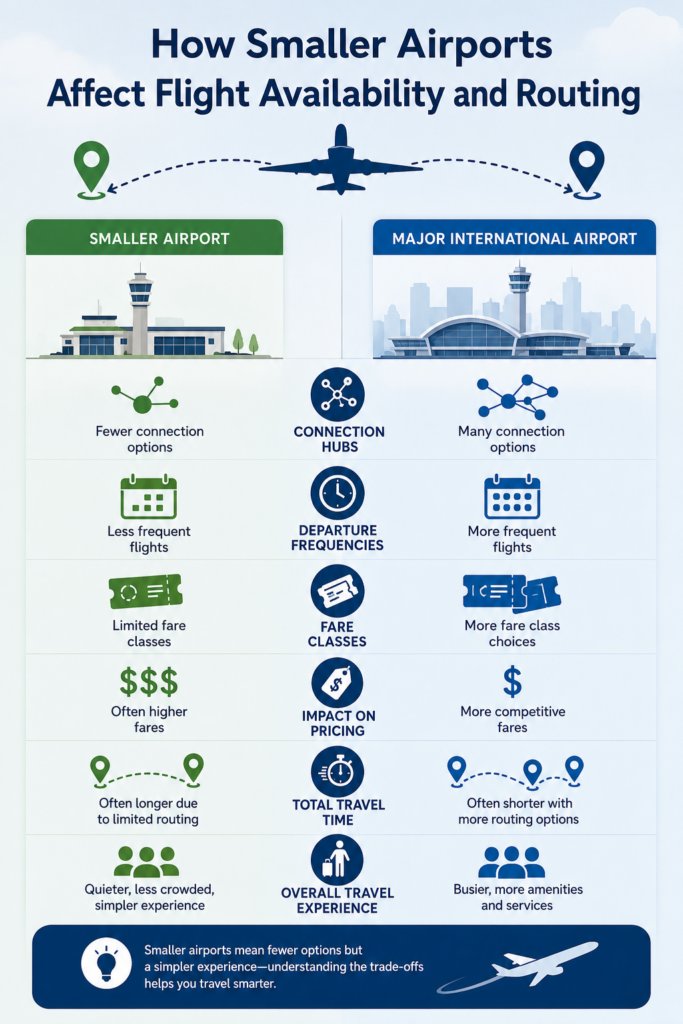
Smaller airports affect flight availability and routing because airlines offer different connection hubs, departure frequencies, and fare classes compared to major international gateways. These structural differences directly change ticket pricing, total travel time, and route options.
Departure from a smaller airport often means connecting through a different hub than flights leaving from a primary airport. Instead of routing through a large international gateway, airlines may use mid-sized hubs with lower congestion and different tax structures. Since airport taxes and passenger fees vary by location, total fare construction can differ even when the final destination remains the same.
Flight frequency also impacts availability. Major airports may offer multiple daily departures on the same route, while smaller airports operate fewer flights. Fewer departures can limit schedule flexibility, but they can also increase promotional pricing when airlines aim to maintain seat occupancy on less frequent services.
Regional airline partnerships are common at secondary airports. Travelers may begin their journey on a regional carrier that connects to a larger international hub. Regional aircraft have different operating economics and seating capacity. Airlines price these feeder segments strategically to maintain consistent passenger flow into their long-haul networks.
Airport selection also affects taxes and surcharges. Certain large airports impose higher passenger service charges and security fees. Smaller airports may apply lower airport-related surcharges, which can reduce total ticket cost even when base fares are similar.
How to Compare Smaller Airports When Booking Flights
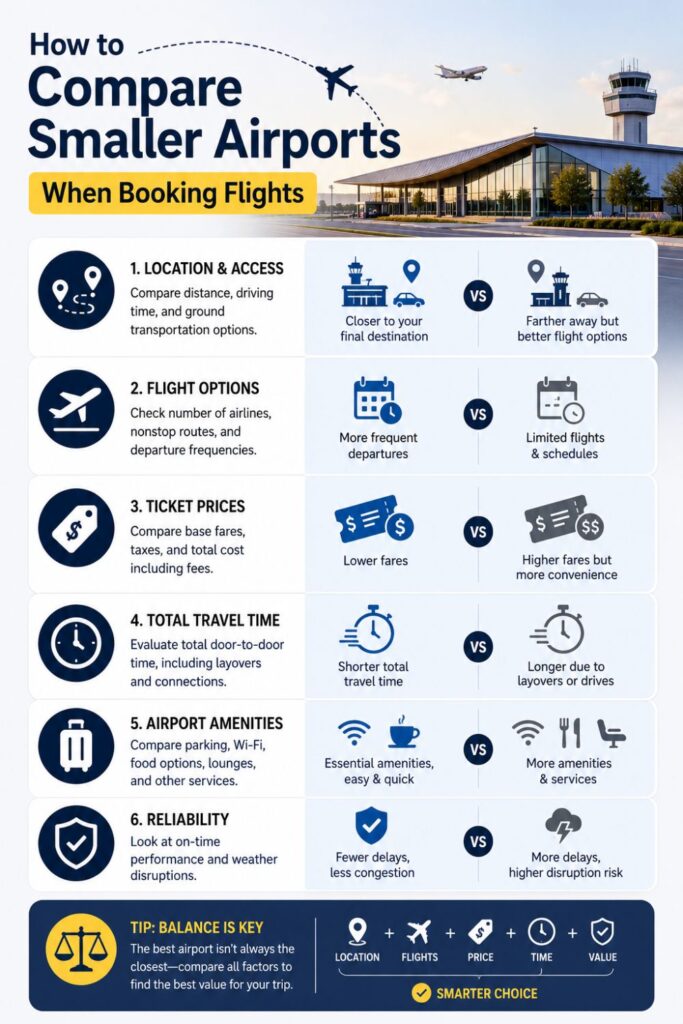
Comparing smaller airports when booking flights requires evaluating total fare structure, airline mix, route availability, and full trip cost — not just the lowest visible base fare. Airport selection directly influences airfare pricing, connection options, and travel time.
Start by searching all departure airports within reasonable driving distance. Most flight comparison platforms allow you to select multiple airports or “all airports” within a city region. This reveals fare differences caused by airport fees, airline competition, and route distribution rather than assuming all departures from one city cost the same.
Understanding how to filter results correctly improves airfare comparison accuracy. Flexible date views, fare calendars, and multi-airport search tools are essential when learning how to use flight comparison sites effectively for comparing departure airports. Comparing airports without applying these filters can hide lower fare classes that are available only on specific travel dates.
Next, evaluate which airlines operate from each airport. Smaller airports often host low-cost carriers that publish lower entry-level fares but charge separately for baggage, seat selection, and priority boarding. Compare the total ticket cost after add-ons rather than comparing the base fare only.
Ground transportation costs must also be included in your decision. A smaller airport located farther from your home may require additional fuel expense, parking fees, or shuttle transfers. Calculate the total travel cost from home to the destination before selecting the departure airport.
Fare behavior can also differ based on timing. Price fluctuations follow demand signals and booking curves similar to when flight prices drop before departure patterns observed across different routes. Monitoring price changes across multiple airports can reveal which departure point experiences earlier or more frequent fare drops.
Finally, review connection times and total travel duration. A cheaper fare from a smaller airport may include longer layovers. Compare travel efficiency alongside ticket pricing to ensure savings do not significantly increase total journey time.
Common Mistakes When Evaluating Smaller Airport Fares
Travelers often misinterpret lower fares from smaller airports because they compare only headline prices instead of full ticket structure, route efficiency, and total travel cost. Misreading these variables can eliminate potential savings.
One common mistake is assuming that a smaller airport always guarantees cheaper flights. Pricing depends on airline competition, route frequency, and demand patterns. Some secondary airports serve limited routes with minimal competition, which can result in equal or even higher fares than major hubs.
Another frequent error is ignoring fare conditions. Low base fares may exclude baggage, seat selection, or ticket flexibility, since airlines often separate ancillary services from the base ticket price. Before confirming a booking, review fare rules and compare them with what airlines charge extra for so you can calculate the true total cost and avoid unexpected add-on fees.
Travelers also underestimate the connection impact. Smaller airports may require additional transfers or longer layovers. Extended connection times can increase total travel duration and reduce schedule reliability. A modest price reduction may not justify significantly longer travel time.
Failing to compare the round-trip structure is another issue. Outbound pricing from a smaller airport may be competitive, while return fares from the same airport could be higher. Always review both directions before booking to avoid an imbalance in total trip cost.
Some travelers also overlook fare class availability. Lower booking classes at smaller airports can sell out quickly due to limited seat inventory. Waiting too long may eliminate the initial price advantage.
Choose Smaller Airports, Compare Flights
Using smaller airports strategically means comparing departure points based on cost structure, airline mix, and route efficiency before finalizing ticket purchase. Airport selection should be treated as part of fare evaluation, not as a fixed assumption.
Begin by identifying all reasonable departure airports. Compare base fare, fare class rules, and airline type operating each route. Determine whether pricing reflects competitive pressure or limited availability.
Review total trip cost, including airport access, parking, shuttle services, and potential baggage fees. A lower ticket price must translate into lower overall travel cost to provide real value.
Monitor price trends across multiple airports instead of checking only once. Fare changes can occur at different times depending on demand at each airport. Comparing pricing patterns improves decision timing.
Finally, balance savings against schedule efficiency. Select the airport that offers the strongest combination of price, travel duration, and reliability rather than choosing solely on the lowest fare.
Airport comparison is a structured step within the booking process. When used correctly, it expands your fare options and increases the likelihood of securing competitively priced tickets without compromising travel efficiency.
FAQs
Do smaller airports offer better last-minute flight deals?
Smaller airports can sometimes display lower last-minute fares when airlines need to fill remaining seats on low-frequency routes. However, inventory is limited, and once lower fare classes sell out, prices may increase quickly. Comparing multiple nearby airports improves last-minute booking flexibility.
Are airport taxes lower at smaller regional airports?
In many cases, regional airports apply lower passenger service charges and facility fees than large international hubs. These reduced airport taxes can lower the total ticket price even when the airline’s base fare appears similar.
Can departing from a smaller airport change airline alliance options?
Yes. Smaller airports may offer fewer alliance carriers, which can affect mileage accrual, elite benefits, and connection networks. Travelers using loyalty programs should verify airline partnerships before selecting the departure airport.
Do smaller airports have fewer nonstop international flights?
Most smaller airports operate limited nonstop long-haul routes. Travelers typically connect through a domestic or regional hub. This routing structure can affect total travel time, fare construction, and ticket flexibility.
Is flight availability more limited at smaller airports during peak travel seasons?
Yes. Secondary airports often operate fewer daily departures. During peak seasons, seats may sell out faster due to lower capacity. Booking earlier improves access to lower fare classes and preferred schedules.
Can smaller airports affect refund or ticket change policies?
Ticket rules are determined by fare type and airline policy rather than airport size. However, smaller airports often host low-cost carriers, which may apply stricter change and refund conditions. Always review fare restrictions before confirming payment.
How can I identify whether a smaller airport is truly cheaper for my route?
Search the same destination from multiple departure airports using flexible date filters and compare total ticket cost, airline type, connection time, and ancillary fees. Evaluating complete fare structure — not just the lowest displayed price — provides accurate comparison results.