
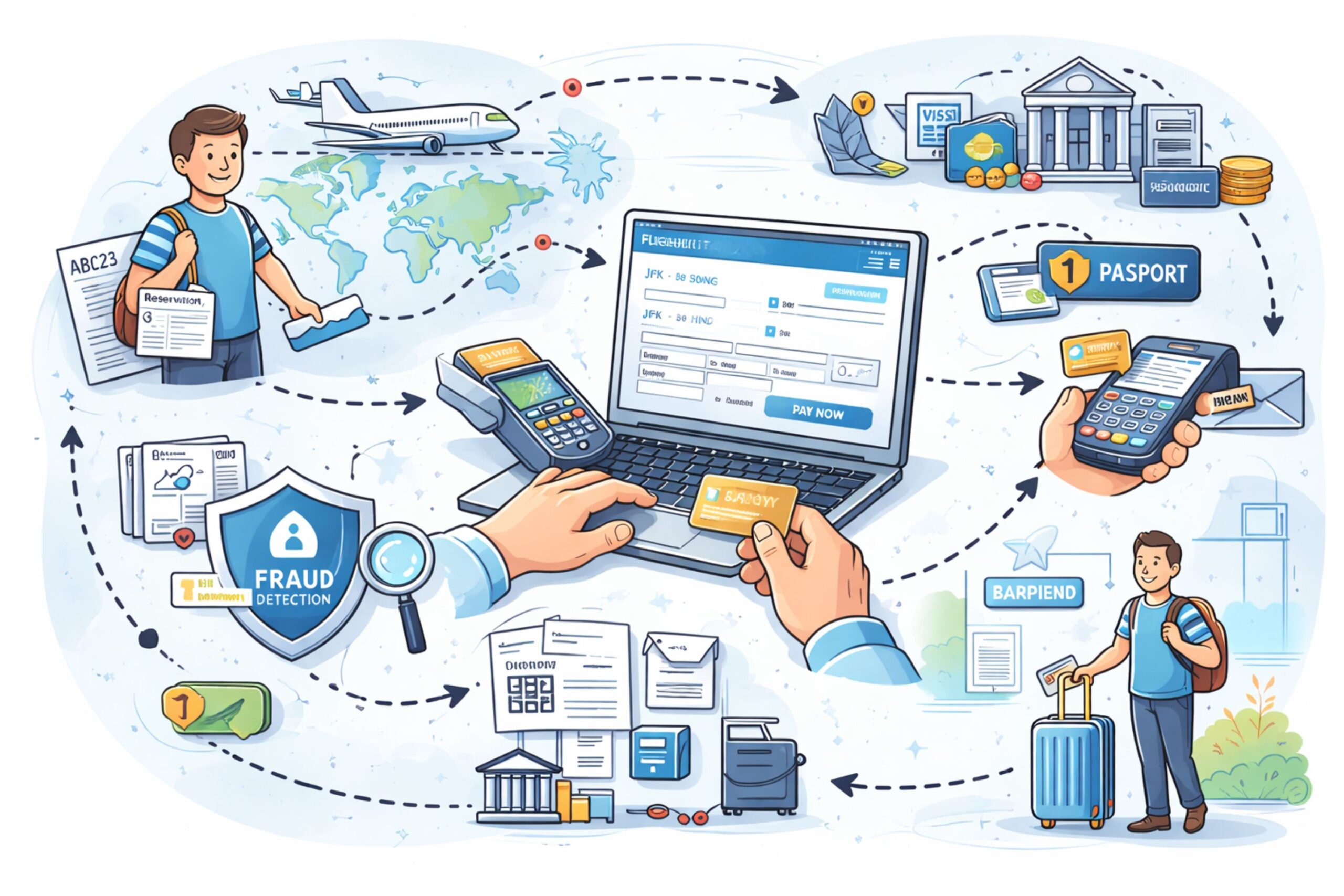
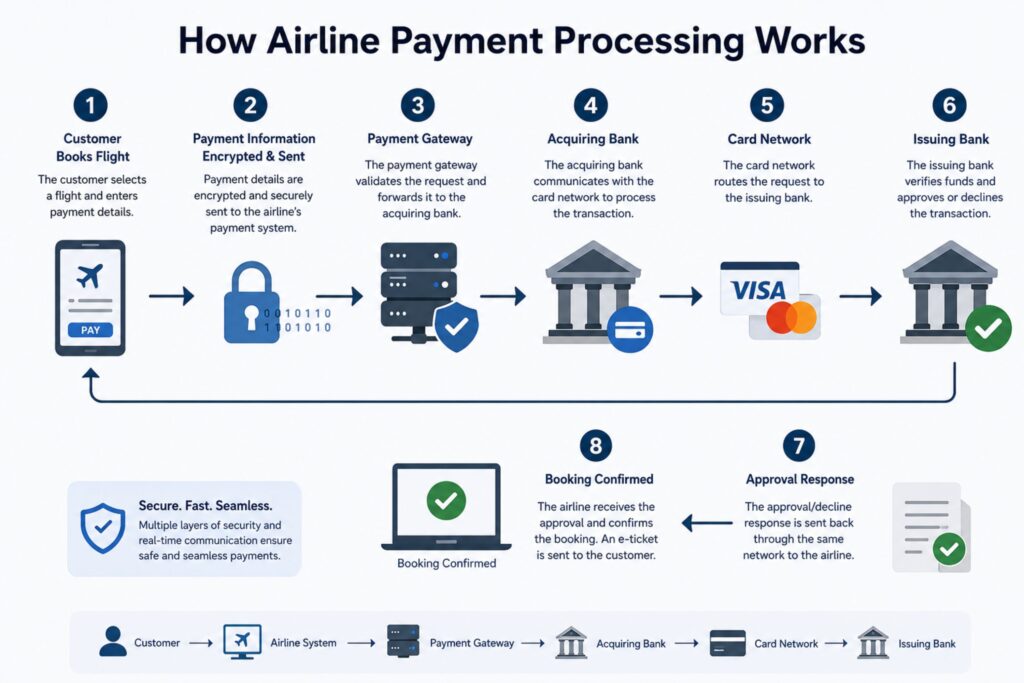
Airline payment processing works by securely authorizing, validating, and settling your ticket payment through multiple systems before your booking is confirmed. When you pay for a flight, the transaction passes through a payment gateway, fraud checks, airline reservation systems, and settlement networks before an e-ticket is issued.
Understanding how airline payment processing works helps travelers avoid declined transactions, booking failures, duplicate charges, and refund delays. This knowledge allows you to choose safer payment methods, confirm transactions correctly, and secure ticket pricing before fare availability changes.
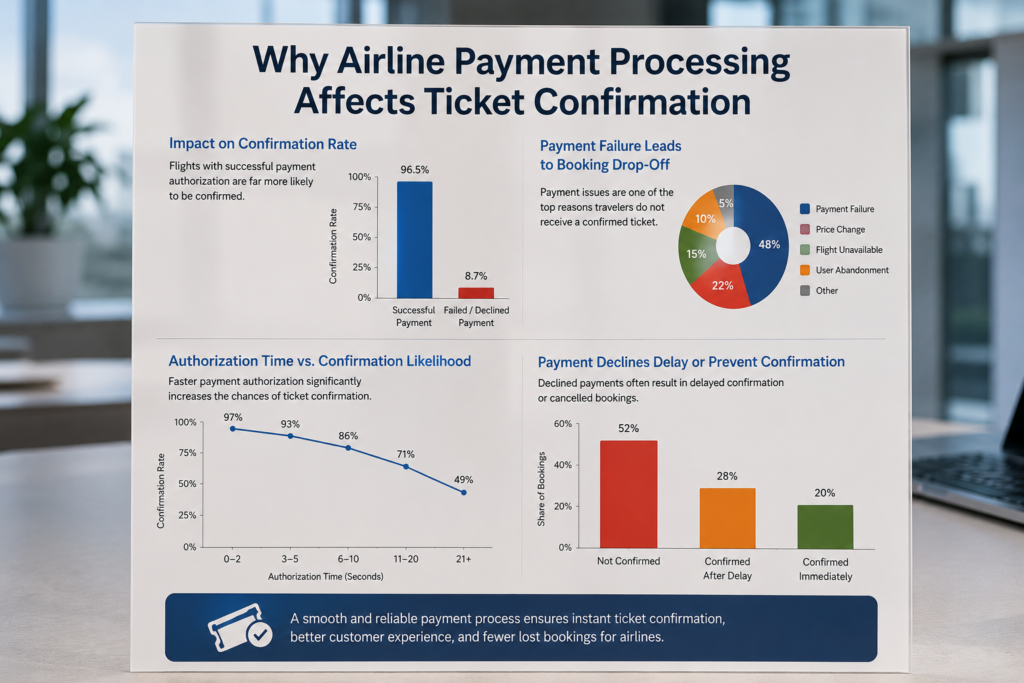
Why Airline Payment Processing Affects Ticket Confirmation
Airline payment processing directly affects ticket confirmation because a flight reservation becomes a valid e-ticket only after payment authorization is approved and settlement is initiated. A booking reference alone does not guarantee the seat or the fare. Confirmation occurs only when the transaction clears, and the airline issues a ticket number.
When a Passenger Name Record (PNR) is created, the airline temporarily allocates inventory in a specific fare class. That allocation remains conditional until the payment gateway confirms authorization from the issuing bank.
Airlines manage seat inventory using real-time revenue management systems. If authorization fails, the system automatically releases the seat back into availability. On high-demand routes, this can trigger an immediate fare class change.
Because ticket pricing follows structured revenue logic tied to what is dynamic pricing for airlines, even a short payment delay can result in a higher fare. The system does not preserve pricing once authorization is declined.
Knowing this process helps travelers prioritize payment reliability, complete transactions without interruption, and reduce the risk of losing selected fares.
Step-by-Step: What Happens When You Pay for a Flight
Airline payment processing follows four core stages: reservation creation, payment authorization, fraud screening, and ticket issuance. Each stage must succeed before the airline finalizes your electronic ticket.
1. Reservation Creation
Reservation creation occurs when the airline system generates a booking record and temporarily holds the selected fare class. This stage secures availability but does not issue a ticket.
The system records:
- Fare basis code and booking class
- Flight numbers and route
- Passenger name details
- Taxes, carrier-imposed surcharges, and total fare
- Booking reference (PNR)
At this point, the reservation exists in the airline’s inventory system, but the seat remains conditional. The hold duration depends on fare rules and system configuration.
2. Payment Authorization
Payment authorization verifies that your bank approves the transaction amount and confirms sufficient funds or credit limit. This step determines whether the airline can proceed with ticket issuance.
The payment gateway encrypts card details and transmits them to the relevant card network. The network routes the request to the issuing bank for approval. The bank performs balance verification, fraud scoring, and authentication checks such as 3D Secure.
If approved, the bank places a temporary authorization hold. This holds reserves funds but has not yet finalized settlement.
If declined, the reservation may automatically cancel, and the fare class may return to inventory.
Before submitting payment, travelers should verify key booking details such as passenger name accuracy, fare conditions, baggage rules, and refund eligibility. Practical guidance covered in what to pay attention to when buying flight tickets online highlights common checkout errors that can cause payment declines or ticketing delays, especially on international routes where currency, identity verification, and cross-border processing rules apply.
3. Fraud Screening
Fraud screening evaluates transaction risk before ticket issuance. Airlines use automated fraud detection systems to prevent chargebacks and unauthorized purchases.
Risk indicators can include:
- Billing country different from departure country
- One-way long-haul bookings
- Premium cabin purchases
- Multiple rapid payment attempts
- Inconsistent IP or device data
If a transaction is flagged, ticket issuance pauses for manual or automated review. During this period, fare availability may change depending on demand.
Fraud checks are stricter for cross-border transactions and last-minute bookings because these carry a higher chargeback risk for airlines.
4. Ticket Issuance
Ticket issuance is the final stage of airline payment processing. It occurs only after successful authorization and fraud clearance.
The system generates a 13-digit electronic ticket number linked to the PNR. At this point:
- The seat is fully confirmed
- The fare is locked under the issued ticket
- The booking becomes eligible for check-in
Travelers should confirm they receive both a booking reference (PNR) and a valid 13-digit e-ticket number. The PNR shows that a reservation exists, but only the ticket number confirms that payment has cleared and the seat has been officially issued.
Airports and airlines verify passengers through the electronic ticket record stored in their system. Practical details on checking e-ticket validity at the airport explain which confirmation documents are accepted at check-in counters, self-service kiosks, and boarding gates.
Without a ticket number, the reservation remains incomplete, even if payment appears pending on the bank statement.
How Different Payment Methods Work in Airline Systems
Different airline payment methods follow different authorization paths, settlement timelines, and fraud verification layers. Selecting the right method can reduce transaction failures and simplify refund handling.
Credit and Debit Cards
Credit and debit cards provide near-instant authorization and are the most widely supported airline payment option.
Transactions are processed through international merchant accounts. Because many airlines operate globally, banks may classify the charge as a cross-border transaction. This can trigger additional authentication, such as one-time passwords or 3D Secure verification.
Card payments typically result in the fastest ticket issuance and are easier to dispute if errors occur.
Bank Transfers
Bank transfers require full fund settlement before ticket issuance. Unlike card authorization, transfers are not immediately verified unless processed through instant payment systems.
If the airline waits for funds to clear, fare availability may change during the delay. This makes bank transfers less suitable for time-sensitive bookings or limited-seat promotions.
Travelers should verify whether the airline guarantees fare protection during transfer processing.
Digital Wallets (Apple Pay, Google Pay)
Digital wallets process payments using tokenized card credentials and device-level authentication, such as biometric verification.
Because authentication occurs before transaction submission, fraud risk is often lower. However, the underlying funding source remains a credit or debit card, and authorization still depends on the issuing bank.
Digital wallets can reduce input errors and speed up checkout, especially on mobile bookings.
Buy Now, Pay Later (BNPL)
Buy Now, Pay Later services approve the traveler through internal credit assessment and immediately pay the airline in full.
From the airline’s perspective, settlement occurs instantly. Ticket issuance proceeds without delay once the BNPL provider confirms payment.
The traveler then repays the installment provider according to agreed terms. Eligibility depends on credit evaluation and regional availability.
Choosing the correct payment method reduces the risk of authorization failure, fare loss, and booking disruption during the final stage of flight purchase.
FAQs
How long does airline payment settlement take after authorization?
Payment authorization happens within seconds, but settlement between the airline’s acquiring bank and the issuing bank can take 1–3 business days. During settlement, the ticket remains valid, but the final fund transfer is still being processed in the background through clearing networks.
Can currency conversion affect airline payment approval?
Yes. When booking international flights, currency conversion is handled either by the airline’s payment processor or your issuing bank. Exchange rate differences and foreign transaction limits can cause authorization failures if the converted amount exceeds your available balance.
Why do some airline payments show as pending for several days?
A pending charge indicates that the bank has authorized the transaction but final settlement has not yet completed. This is normal in cross-border airline transactions and does not mean the booking is unconfirmed if a valid ticket number has been issued.
What happens if payment is approved but the ticket is not issued?
If payment is approved but ticket issuance fails due to a system interruption, the reservation may remain unticketed. In this case, airlines typically void the authorization within a few days, or customer support manually reissues the ticket using the existing PNR.
Do airlines charge different processing fees based on payment method?
Some airlines apply payment surcharges depending on the method used. For example, certain corporate cards or regional payment systems may incur additional processing fees due to higher merchant costs.
Can airline payment processing trigger temporary card limits?
Yes. Large international ticket purchases may activate security controls on your card, especially if the transaction exceeds normal spending behavior. Banks may temporarily freeze the card until identity verification is completed.
Is airline payment processing different for group bookings?
Group bookings often use alternative billing workflows, including deposit payments or invoice-based settlement. Full ticket issuance may occur only after final passenger names are confirmed and the remaining balance is paid.
How do chargebacks impact airline bookings?
If a traveler disputes a charge through the bank, a chargeback process begins. Airlines may suspend the ticket or restrict future bookings until the dispute is resolved, as chargebacks increase fraud risk for carriers.
Can installment payments affect fare rules or ticket flexibility?
Installment providers do not change airline fare rules. The refundability, change penalties, and baggage conditions remain based on the purchased fare class, not the payment structure.
Do airline payment systems differ between direct booking and travel agencies?
Yes. When booking through an online travel agency, payment is processed through the agency’s merchant account first. This can affect refund routing, processing speed, and customer service responsibility.
Why do airlines sometimes require additional identity verification after payment?
Airlines may request documentation if fraud detection systems identify inconsistencies in billing data, passenger name, or booking pattern. This protects both the airline and the cardholder from unauthorized transactions.
Can airline payment processing affect travel insurance activation?
Yes. Travel insurance policies linked to a ticket typically activate only after successful ticket issuance. If payment fails or remains pending, the insurance coverage may not begin until confirmation is completed.